

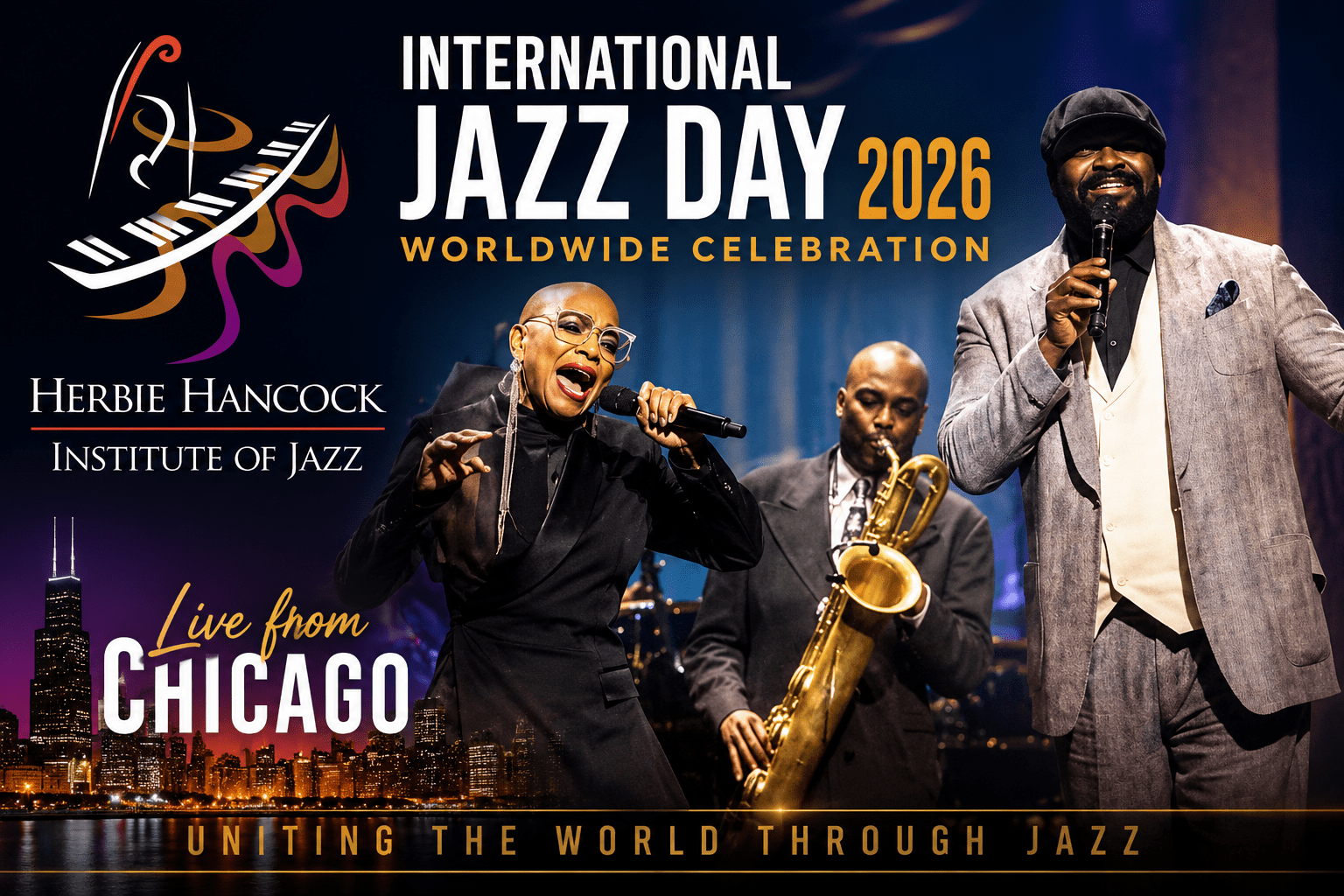
International Jazz Day 2026 once again proved that music remains one of humanity’s most powerful common languages. From intimate performances in local communities to major concerts on world-renowned stages, the annual celebration united artists, educators, and audiences across 196 countries and all 50 U.S. states. The festivities culminated with a spectacular All-Star Global Concert at Chicago’s iconic Lyric Opera House.
For one evening, Chicago became the center of the jazz universe.
More than 40 internationally acclaimed musicians gathered to celebrate not only the art form itself but also the enduring role jazz plays in cultural diplomacy, education, and global understanding. The lineup featured legendary artists including Herbie Hancock, Dee Dee Bridgewater, Gregory Porter, Marcus Miller, Dianne Reeves, Christian McBride, Béla Fleck, Jacob Collier, Buddy Guy, Kurt Elling, and many others.
The evening opened with a tribute to Chicago’s extraordinary musical legacy. Dee Dee Bridgewater and Gregory Porter energized the audience with a memorable rendition of “The In-Crowd,” honoring the late Chicago jazz icon Ramsey Lewis. Chicago native Herbie Hancock followed with a fresh interpretation of his classic “Watermelon Man,” blending decades of musical evolution into one performance.
The city’s blues tradition was equally celebrated. Blues legend Buddy Guy joined forces with Christone “Kingfish” Ingram for a powerful performance of “Damn Right, I’ve Got the Blues,” reminding audiences why Chicago remains synonymous with American blues.
Among the night’s most moving moments was Jacob Collier’s tribute to the late Quincy Jones, whose remarkable career was deeply connected to Chicago. His heartfelt performance of “She’s Out of My Life” and “Soul Bossa Nova” showcased both reverence and innovation.
The concert continued to highlight jazz’s ability to transcend genres and borders. Brazil’s Bia Ferreira delivered a radiant performance of “Antes de Ir,” while Robert Glasper blended jazz and hip-hop influences during an inventive presentation of “Funny Rabbit.” Béla Fleck’s “Touch and Go” demonstrated the seamless intersection of bluegrass, jazz fusion, and classical music traditions.
As the evening progressed, audiences were treated to timeless standards and modern masterpieces. Dianne Reeves brought elegance to Duke Ellington’s “In a Sentimental Mood,” while Kurt Elling’s interpretation of “Dat Dere” honored the legacy of Art Blakey and the Jazz Messengers.
The closing performances paid tribute to some of jazz’s most influential voices. Gonzalo Rubalcaba energized the crowd with “Caravan,” Marcus Miller honored Miles Davis with a powerful rendition of “Tutu,” and the concert concluded with the traditional International Jazz Day finale, John Lennon’s “Imagine.”
The performance brought the audience to its feet and perfectly captured the spirit of the day: unity, hope, and connection through music.
Established by UNESCO in 2011, International Jazz Day continues to serve as a global reminder that jazz is far more than a musical genre. It is a cultural bridge that connects people across nations, languages, and generations. Under the leadership of UNESCO Goodwill Ambassador and jazz legend Herbie Hancock and UNESCO Director-General Khaled El-Enany, the annual celebration now reaches more than one billion people worldwide through performances, educational initiatives, community outreach programs, and digital broadcasts.
In a world often divided by borders and differences, International Jazz Day 2026 offered something increasingly valuable: a shared rhythm that reminded us all of our common humanity.